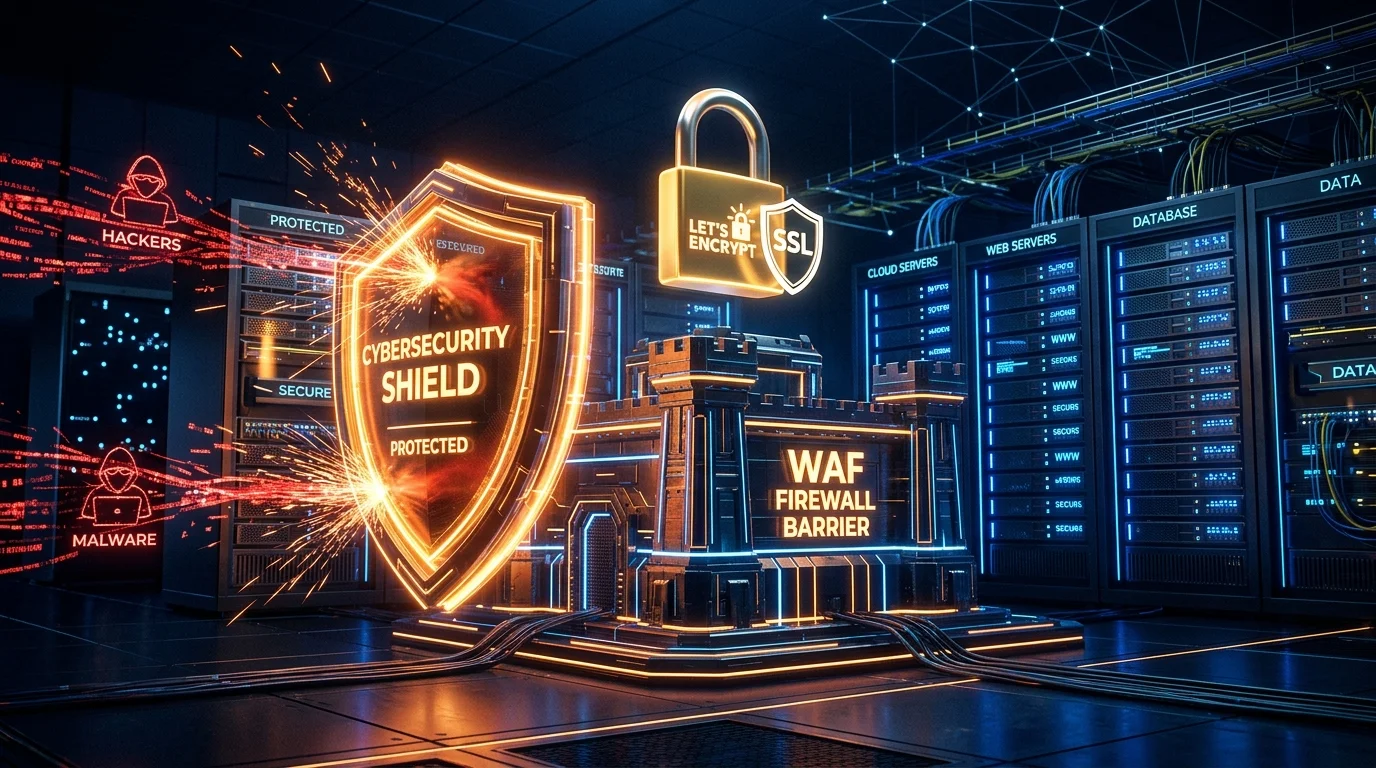
Executive Summary: Why Cybersecurity Safeguards Your Business Continuity
Website cybersecurity comprises the end-to-end technical protocols, server-level defenses, and operational best practices deployed to protect your company's digital property, client databases, and institutional brand standing from illicit intrusions, malware infections, brute-force hacking, and data breaches. For modern commerce, rigorous cybersecurity represents a fundamental duty of care safeguarding client trust.
The Dangerous Myth: "Our Business is Too Small to Attract Hackers"
A prevalent misconception among small business owners and startups is assuming that cybercriminals exclusively target major banking consortiums or multinational conglomerates. Real-world threat intelligence reveals the exact opposite:
The vast majority of website breaches are not executed manually by human operatives; they are orchestrated by automated malicious botnets continuously crawling the global web to identify unpatched plugins, outdated PHP frameworks, and weak administrative credentials. Once a vulnerability is detected on an unhardened portal, bad actors exploit it for disruptive activities:
- SEO Spam Defacement & Illicit Redirection: Injecting hidden backdoors and parasitic landing pages promoting predatory gambling portals, triggering immediate domain blacklisting across Google Safe Browsing.
- E-Commerce Client Data Theft: Deploying stealth credit card skimming code on checkout endpoints to harvest customer payment details, phone numbers, and credentials.
- Botnet Mail Relay Exploitation: Hijacking hosting mail servers to transmit millions of fraudulent phishing messages, resulting in global IP reputation destruction and domain blacklisting.
10 Essential Website Security Checklists for Businesses in 2026
Deploy these ten critical defenses across your corporate web architecture:
1. Enforce Comprehensive SSL/TLS (HTTPS) Encryption
An SSL certificate encrypts bidirectional communications between client browsers and hosting servers. Without active SSL certificates, modern browsers (Chrome, Safari, Edge) display prominent "Not Secure" alerts, immediately destroying customer purchasing confidence.
2. Mandate Two-Factor Authentication (2FA) for Administrative Logins
Relying solely on passwords in 2026 is inadequate. Enforce Two-Factor Authentication (2FA) across all CMS administrative dashboards and hosting cPanel accounts via modern authenticator applications (Google or Microsoft Authenticator), preventing access even if passwords become compromised.
3. Deploy Web Application Firewalls (WAF) & ModSecurity
A hardened WAF functions as a perimeter gatekeeper, inspecting incoming HTTP request payloads to intercept SQL Injections, Cross-Site Scripting (XSS), and Local File Inclusion (LFI) attempts before malicious code reaches your application.
4. Practice the 3-2-1 Automated Offsite Backup Methodology
No security perimeter is entirely invulnerable. Maintain automated daily snapshots stored on isolated offsite cloud infrastructure. The 3-2-1 backup strategy ensures pristine recovery points are always available for 1-click restoration during emergencies.
5. Maintain Strict Patch Management for PHP, CMS, Themes, and Plugins
Over 90% of WordPress security compromises trace directly to neglected, outdated third-party extensions containing publicly cataloged CVE vulnerabilities. Regularly upgrade to actively maintained PHP versions (PHP 8.2 or 8.3) for enhanced execution security.
6. Restrict Login Thresholds and Block xmlrpc.php Endpoints
Implement aggressive rate limiting to blacklist IP addresses failing more than 3 to 5 successive login attempts. Disable legacy xmlrpc.php endpoints unless explicitly required, eliminating major brute-force amplification channels.
7. Utilize Real-Time Malware Scanning Engines (Imunify360)
Modern hosting environments at DutaSpace feature automated Imunify360 enterprise security suites. This technology analyzes uploaded media streams in real-time, quenches stealthy backdoor scripts, and defends against malicious botnet intrusions.
8. Harden File and Directory Permission Flags
Ensure file system flags conform to industry standards: directories must strictly adhere to 755, while PHP code files must reflect 644. Never set permissive 777 flags, which invite rogue script injection.
9. Enforce Cryptographically Complex, Unique Passwords
Eliminate human-guessable credentials like birthdays, corporate names, or reused passwords across external accounts. Leverage enterprise password managers to generate robust 16+ character alphanumeric strings.
10. Suppress System Version Signatures (Security Through Obscurity)
Disable public WordPress generator meta tags and HTTP server banners, depriving attackers of immediate version fingerprints used to orchestrate targeted exploits.
Threat Defense Matrix: Common Attacks vs DutaSpace Safeguards
| Cyber Threat Category | Commercial Risk Impact | DutaSpace Defense Layer |
|---|---|---|
| Brute-Force & Credential Stuffing | Account takeover, resource exhaustion | Automated IP Throttling + 2FA Gateways |
| Malware & Backdoor Injections | Google search penalties, brand defacement | Imunify360 Automated Real-Time Disinfection |
| Network & Application DDoS Surges | Complete site outages, operational halt | Tier-3 Jakarta Multi-Layer DDoS Scrubbing |
| Neighbor Account Contamination | Cross-account infection on shared nodes | CloudLinux CageFS Virtual Container Isolation |
| Catastrophic Data Loss (Human Error) | Permanent loss of historical business records | Automated Daily Offsite Backups & 1-Click Restore |
Frequently Asked Questions (FAQ)
Can DutaSpace assist with cleaning compromised files from previous hosting accounts?
Yes. During your complimentary migration onboarding, our security engineers inspect directory trees and sanitize detected backdoor shells, ensuring your site launches on DutaSpace in a pristine state.
Are resource-heavy security plugins required alongside DutaSpace hosting?
No. Because enterprise-level Imunify360 protection, ModSecurity WAF, and CloudLinux CageFS containers operate directly at the infrastructure level, you avoid deploying bloated PHP security plugins that drain server RAM.
Conclusion: Cybersecurity is an Indispensable Business Investment
The operational cost of maintaining proactive cybersecurity controls is negligible compared to the devastating financial and legal aftermath of a publicized customer data compromise. Implementing these security checklists grants you peace of mind to focus wholly on commercial scaling.
Safeguard your corporate web presence with DutaSpace. Benefit from enterprise-grade perimeter firewalls, automated daily malware sanitization, and resilient Tier-3 infrastructure built to preserve customer trust. Request a security audit today.